What Is Rent to Own Houses for Low Income Families
Rent-to-Own Programme Rehabilitates Abandoned and Foreclosed Backdrop
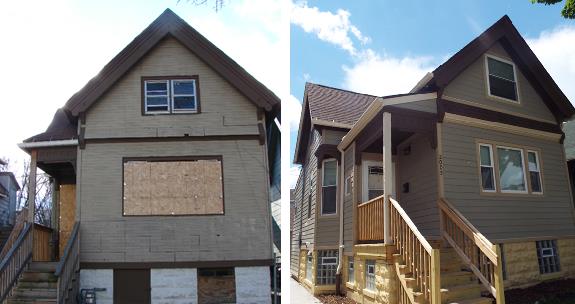
In the rent-to-own program, LBWN and Impact Vii invested an average of $125,000 per home in renovation costs, restoring abandoned, foreclosed homes to livable condition. Prototype courtesy of Touch on 7. A partnership between a community development fiscal institution and a community development corporation is meeting 2 needs in Milwaukee, Wisconsin. The partnership is both revitalizing neighborhoods with foreclosed properties and providing affordable housing for depression-income families. In June 2009, the city recorded 1,619 bank-endemic and 138 city-endemic foreclosures and more four,000 open foreclosure filings. Milwaukee was facing conditions commonly found in areas with high foreclosure rates: depressed property values, high crime rates, and increased municipal service. Through a collaborative rent-to-ain program, Bear upon Seven and Layton Boulevard West Neighbors (LBWN) have rehabilitated vacant residences in the Silvery City, Burnham Park, and Layton Boulevard neighborhoods. The plan allows low-income residents to pay an affordable rent for 15 years and receive a credit toward a downpayment if they choose to purchase the business firm subsequently that time.
Program Features
LBWN has renovated foreclosed properties through its Turnkey Renovation program and constructed townhouses for a rent-to-ain program. Bear upon Seven has helped finance, develop, and manage properties in distressed communities throughout the state. In 2011, the two nonprofits combined their skillsets in the rent-to-own program for foreclosed properties in the Virtually Southward Side of Milwaukee. Within a year, the partners had identified and purchased 21 single-family houses, a duplex with 2 residential units, and a live/work building.
The renovations, which were completed in summer 2014, included replacing roofs, windows, siding, and hot water heaters, also equally plumbing, electrical, and HVAC systems, according to Todd Hutchison, consulting director of real estate development at Bear upon Seven. Renovation costs for each residential unit in the hire-to-own program averaged more than $125,000. The renovated homes feature Energy STAR® appliances and meet Wisconsin Environmental Initiative's Green Built Homes standards for remodeling.
Tenants for the renovated units were selected based on income in accordance with Depression-Income Housing Tax Credit (LIHTC) program guidelines. Of the program's 24 residential units, 17 are set aside for households earning no more than 50 percent of the area median income (AMI), and 7 are reserved for households earning upwards to lx percent of AMI. Tenants were besides screened to ensure that they did not have a criminal record, had non been evicted, and had not recently alleged defalcation.
Affect Seven will manage the rental units for 15 years. At the end of the rental period, each tenant who decides to buy the home volition receive a credit of approximately $36,000 to exist used for the downpayment. To set up tenants to ain a home, the partnership will sponsor annual homebuying classes provided by local banks and other local service providers.
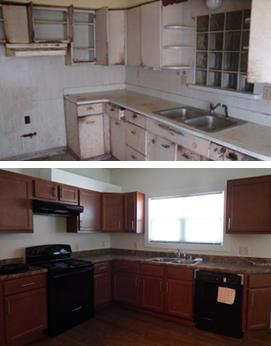
Kitchens in the renovated homes feature efficient Energy STAR appliances. Epitome courtesy of Impact 7. To further raise the neighborhood, the partnership likewise purchased a vacant iii,000-square-pes commercial building adjacent to the hire-to-ain plan's live/piece of work building forth National Artery, a commercial corridor in the Silver City neighborhood. Renovations to the building replaced the front windows and restored the tin ceiling and skylight, revitalizing the storefront for a new local concern. To identify a suitable tenant for the commercial space, the partnership held a business organisation plan competition. In addition to a lease for the property, the winner received $5,000 from a local foundation for startup costs, as well every bit free professional person services and 3 months' rent to help the business get underway.
Funding
The $6.iii million rent-to-own plan relied on funding from various sources. The project received $4.8 million in disinterestedness from the auction of LIHTCs provided past the Wisconsin Housing and Economic Development Authority. Boondocks Bank provided a $275,000 loan and administered a $192,000 forgivable loan from the Federal Domicile Loan Bank of Chicago. The city also contributed funds from Dwelling house Investment Partnerships ($158,000) and the Neighborhood Stabilization Programme ($660,000). Bear upon Seven and LBWN covered the balance of the programme costs.
Results and Impacts
As of September 2014, all 24 dwellings have been fully renovated and rented. The commercial space is now used as a store selling artisanal wood kitchen products made in the shop in the rear of the building. In improver, the next alive/work building is occupied by a seamstress who volition use the storefront space to expand her business concern. As a 2014 Milwaukee Awards for Neighborhood Development Innovation finalist, Bear upon Vii and LBWN'southward rent-to-ain program was recognized for revitalizing foreclosed and vacant buildings while also providing affordable housing for low-income families. Hutchison notes that private-market activeness in the area has increased, stating that the "impact of the housing development and the storefront renovations have generated a great deal of interest in the renovation of other neighboring homes and storefronts."
Source:
Affect Seven. due north.d. "LBWN Hire-to-Own Homes." Accessed September 1, 2014; Interview with Todd Hutchison, consulting director of real estate development at Impact 7, 5 September 2014.
×
Source:
Interview with Todd Hutchison, consulting director of real estate development at Impact 7, 5 September 2014; Email correspondence with Todd Hutchison, 23 September 2014.
×
Source:
Touch on 7. due north.d. "LBWN Rent-to-Own Homes." Accessed September 1, 2014; Interview with Todd Hutchison, 5 September 2014; Email correspondence with Todd Hutchison, 23 September 2014; E-mail correspondence with Todd Hutchison, 25 September 2014.
×
Source:
Interview with Todd Hutchison, v September 2014; E-mail correspondence with Todd Hutchison, 23 September 2014.
×
Source:
Interview with Todd Hutchison, 5 September 2014; E-mail correspondence with Todd Hutchison, 23 September 2014.
×
Source:
E-mail correspondence with Todd Hutchison, 25 September 2014.
×
Source:
Interview with Todd Hutchison, 5 September 2014; E-mail correspondence with Todd Hutchison, 25 September 2014.
×
Source:
Email correspondence with Todd Hutchison, 23 September 2014; E-mail correspondence with Todd Hutchison, 25 September 2014.
×
Source: https://www.huduser.gov/portal/pdredge/pdr_edge_inpractice_102014.html#:~:text=The%20program%20allows%20low%2Dincome,the%20house%20after%20that%20time.
0 Response to "What Is Rent to Own Houses for Low Income Families"
Post a Comment